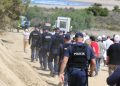
Dozens of local residents and activists gathered on Saturday, May 23, at the Narta Lagoon to protest the barbed-wire fencing of Pishë Poro beach – part of the protected Vjosa-Narta landscape – by a construction company that has obtained permission from the Albanian government to develop a large-scale tourist resort in the area.
The protesters carried banners in defence of nature and against what they described as oligarchic interests – local businessmen linked to the government whom they accuse of illegally seizing their property.
“Vlora belongs to Albania! Not to the mafia, not to the oligarchy,” read one placard, as demonstrators faced a cordon of police officers deployed to protect the construction site and heavy machinery.
The company developing the resort, Zvërnec South Adriatic Development, is registered offshore through a Dutch trust structure, while its ultimate beneficial owners remain anonymous. US media reports have linked the project to two Qatari billionaire brothers and Jared Kushner, the son-in-law of US President Donald Trump.
However, documents obtained by BIRN through freedom of information requests reveal that behind the polished public profile of the US presidential family lies a local network of individuals and companies that includes a businessman accused of ties to the Italian mafia, a former judge who resigned during Albania’s vetting process, the daughter of a lawyer accused of forgery, a company linked to a murdered businessman, and individuals connected to one of Albania’s most powerful oligarchs, Shefqet Kastrati.
The land earmarked for the project has for years been the subject of unresolved ownership disputes and court battles, despite the development permit approved by the National Council for Territory and Water, KKTU, chaired by Prime Minister Edi Rama.
“They do not ask. They are very powerful because they have the state behind them,” said Minella Balliu, one of the residents involved in legal disputes over land ownership in Pishë Poro, who joined the May 23 protest.
In a written response, Prime Minister Rama’s office said that the KKTU was not responsible for verifying property records or ownership-related court disputes, stressing that institutions operate “not on claims, assumptions or prejudices, but on legal documentation and legal mechanisms.”
“Whether or not there are claimants or legal proceedings concerning a particular property has no connection to the legal process of reviewing applications for construction permits,” the Prime Minister’s Office said.
“Property records, meanwhile, are not subject to investigation or adjudication by the executive branch of the state,” it added.
Idyllic paradise
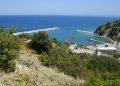
The coastline of Zvërnec and Pishë Poro, one of the most pristine stretches of Albania’s Adriatic coast, with sandy beaches and rugged cliffs descending into the sea, has long attracted the interest of developers and tourism investors.
Thanks to its unspoiled environment and the lagoon that hosts migratory birds such as flamingos, the area enjoys protected landscape status and includes three natural monuments: Limopuo Lagoon, Monastery Island and rare sand dunes that serve as nesting grounds for sea turtles.
Yet this has not prevented successive governments from approving development plans, while prominent businessmen have spent years quietly accumulating hundreds of thousands of square metres of land from Triport to the mouth of the Vjosa River, often purchasing plots from owners whose claims were disputed or subject to court proceedings.
The path for development was cleared in 2021 when the government downgraded the protection status of the Pishë Poro-Narta ecosystem, reduced its protected area by more than 5,000 hectares and approved the construction of an airport in Akërni.
In March 2024, shortly after controversial amendments to Albania’s Protected Areas Law opened the way for five-star developments, Jared Kushner announced plans to invest in both Sazan Island and Zvërnec. Under the initial plans, the Zvërnec project envisaged roughly 10,000 accommodation units along the strip of land separating the Narta Lagoon from the sea.
In August 2024, a company called Zvërnec South Adriatic Development was established. It is owned through a chain of shell companies managed by the Dutch trust company Dutch Trust Management B.V. One of the entities in that offshore structure, Blue Industries Investment Holding B.V., is owned by five anonymous Albanian individuals whose identities are legally shielded because none holds more than 25 per cent of the shares.
Within eight months of its creation, the company secured two development permits from the National Council for Territory and Water for the same areas where Kushner has publicly said he intends to invest. Documents obtained from the National Territorial Development Agency show that one permit application envisages 47,000 square metres of construction on a 2.5-hectare site in Pishë Poro, with a declared investment of 2.6 billion lek.
The offshore company has signed development agreements with individuals and businesses that claim ownership of more than 2.5 million square metres of land, or 251 hectares, in Zvërnec and Narta. Documents and court rulings reviewed by BIRN show that the origins of many of these properties are closely linked to controversial Vlora businessman Artur Shehu, who lives in the United States, and his former lawyer, Pëllumb Petritaj, who has repeatedly faced allegations of document forgery.
Shehu and associates, including Ferdinant Sulaj, signed a development agreement with the project company as owners of a parcel covering approximately 108 hectares. Shehu and members of his family remain involved in several court cases concerning land included in the project. Although he has lived abroad for decades, he has emerged as one of the principal beneficiaries of schemes investigated for the alleged misappropriation of land in the Vlora region. Some of those investigations, involving plots on the Karaburun Peninsula, ended with confiscation orders, while others remain before the courts. Shehu himself has not been charged. However, his name has periodically surfaced in connection with alleged criminal activities and was recently mentioned in an Italian RAI documentary examining past investigations into the mafia organisation Sacra Corona Unita.
Another 78,000-square-metre plot is owned by Feriare Ndreu (Petritaj), the daughter of Pëllumb Petritaj. Petritaj is a well-known figure in Albania’s justice system, having been convicted at first instance and arrested several times. He remained under house arrest until mid-2025 and is still subject to security measures pending the outcome of appeals related to alleged document forgery that granted the Shehu family extensive coastal properties, including land linked to the Pishë Poro resort project. In a public statement issued in May 2024, Petritaj maintained both his own innocence and that of Shehu. His daughter did not respond to BIRN’s request for comment.
Another party to the development agreement is AM-Invest, which owns 25,000 square metres of land. The company belongs to the family of Alaudin Malaj, the former president of the Tirana Court of Appeal. Malaj owns a 25 per cent stake, gifted by his mother, while the remainder is controlled by his father and brother. Malaj also has a history connected to land disputes in the area. In 2013, he issued a civil ruling that awarded the Shehu family 156 hectares of land, overturning a lower court decision. In 2019, acting as rapporteur in a judicial panel, he helped dismiss forgery charges against Petritaj. Both decisions were later quashed by the Supreme Court, which found flaws in the courts’ reasoning.
Malaj resigned in 2020 and was removed from the judiciary through Albania’s vetting process in February 2021. With declared assets of approximately 1.7 million euros, he was considered one of the wealthiest judges in the country. During the vetting process, he claimed he was the victim of a conspiracy. While Malaj could not be reached for comment, his brother, Agron Malaj, rejected any suggestion that the land owned by their company was connected to judicial decisions issued by his sibling.
“These decisions have nothing to do with the property,” he said, explaining that the land had been purchased through the company for around 80 million lek from a businessman unrelated to the Shehu family in 2021.
“The land was purchased by me through the company and paid for through the banking system,” he added.
The largest share of land involved in the project, around 1.2 million square metres, is owned by South Adriatic Development, a company wholly owned by Redi Struga through Smart Construction Invest. Struga, an engineer, also serves as administrator of the design company InfraKonsult. His company acquired properties from various owners, including SERE, a subsidiary of the Balfin Group. Through Albanian Land Development, Struga acts as a key intermediary for Qatari billionaire brothers Ramez and Mohamad Al-Khayyat, who are investing alongside Kushner. He did not respond to questions regarding his role in the project.
The list of co-developers also includes Ferdinant, a furniture manufacturing company owned by businessman Bujar Nasufi, who was killed in early 2025 in circumstances that remain unclear but are believed to be linked to a property dispute in Tirana. The company owns 94,500 square metres of land, despite being listed in liquidation proceedings at Albania’s National Business Centre since 2009.
The Shadow of Kastrati Over the Development
For two days at the end of January, the tranquillity of the picturesque village of Zvërnec was disrupted by tight security measures and a convoy of black SUVs.
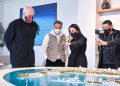
The area along the Narta Lagoon briefly became the focus of public attention due to the visit of Ivanka Trump, the daughter of the President of the United States. Accompanied by a group of architects and businessmen, she toured the historic Monastery of St Mary and met with Prime Minister Edi Rama.
Photographs widely circulated in the media show that Musa Kastrati, the son of businessman Shefqet Kastrati, was also present at the meetings.
Shefqet Kastrati is the owner of Kastrati Group, a conglomerate that controls significant shares of several strategic sectors in Albania, from fuel distribution and insurance to the exclusive management of Tirana International Airport, while also holding major interests in tourism and real estate developments.
The group has long faced allegations of receiving preferential treatment from the government, including the acquisition of concessions and public assets at symbolic prices. Some of its projects, including the Limion port development, have come under investigation over alleged legal violations.
Musa Kastrati’s presence during Ivanka Trump’s visit to Albania and Zvërnec was not the first time his name had surfaced in connection with the planned resort developments on the peninsula and on Sazan Island. In March 2024, The New York Times quoted Kastrati as saying that the company would have a role in the projects Kushner planned to develop in Albania, although the nature of that role had yet to be determined.
Businessmen who own land surrounding the project area also pointed to Kastrati’s involvement, telling BIRN on condition of anonymity that Musa Kastrati had approached them with proposals for cooperation or the purchase of their property.
The company’s name surfaced again shortly after work began to fence off the protected landscape for the development, when activists photographed machinery bearing the company’s branding at the site. Residents of Zvërnec and individuals claiming ownership of the land where the works are taking place also reported encounters with people linked to Kastrati Group when they objected to the construction of the fence.
“A friend invited me for coffee and told me that Kastrati’s grandson [Shefqet Kastrati’s grandson] wanted to meet me,” Minella Balliu said in a telephone interview. He said he later met a man who introduced himself as Dervish Dina.
Kostaq Konomi, the headman of Zvërnec village, also told BIRN by phone that when villagers sought a meeting with the project’s managers after confronting workers who had fenced off the village from part of the coastline, they too met with Dina.
Corporate records show that Dina has business ties to Musa Kastrati. The two were partners in KST Advertising, a company whose ownership has changed hands several times through sales, donations and cancelled contracts – passing from Dina to Musa Kastrati, then to another company within the group, and most recently back to Dina.
According to both interviewees, Dina presented himself as a technical manager and promised meetings with representatives of the development company in exchange for their silence in the media.
Whether through a direct role in the project or through associated individuals and companies, Kastrati Group publicly distanced itself from the works and declined to address concerns raised by environmental activists.
“As has been publicly reported in the media and confirmed through official information, the company carrying out works and planning construction in the Zvërnec area is Zvërnec South Adriatic Development. We believe your questions should be directed to that company,” a company spokesperson told BIRN.
Zvërnec South Adriatic Development could not be reached for comment by telephone. Meanwhile, no office bearing the company’s name could be found at the address listed in the National Business Centre records, on the 12th floor of the European Trade Center, and building staff said they were unaware of its presence there.
Musa Kastrati could not be reached for comment. Dervish Dina answered an initial phone call but then complained about a poor signal and ended the conversation.
Property Disputes and the Revolving Door of Court Rulings
Ever since they learned of plans for a luxury resort associated with Jared Kushner and the Trump family, residents of Zvërnec — many of whom have spent two decades embroiled in land disputes in the area — have been alarmed. On television, they watched forests, meadows and beaches where they had grown up transformed into glossy 3D renderings of villas, while they themselves remained largely in the dark about what was being planned.
For more than two years, every rumour and every burst of international media attention reinforced their fear that they would ultimately lose access to land they say they inherited from their grandparents and hoped to pass on to their children.
That fear became reality in late April 2026, when heavy machinery first appeared in the area. Days later, a metal fence enclosing more than one million square metres of land was erected, blocking access to the beach where generations of villagers had grown up and to ancestral properties claimed within cadastral zone 3951.
“Now they are asking us for a visa to enter our own land,” Kostaq Konomi, the headman of Zvërnec village, told BIRN.
Minella Balliu found himself facing a similar fence further north, in Pishë Poro. There, within cadastral zone 1007, more than 1.3 million square metres of land have been enclosed.
“They have forcibly removed us from our property,” he complained.
Both areas have been the subject of court battles for at least two decades. The dispute over zone 3951 pits residents of Zvërnec against the Shehu family in a conflict that, according to court records and residents’ accounts, dates back to the 1930s.
Residents insist the land was inherited and that they regained ownership rights through Albania’s Law 7501 on land distribution. However, a series of administrative decisions between 2006 and 2009 recognised the claims of the Shehu family, and cadastral records reviewed by BIRN show that a significant portion of the land was registered in the name of Artur Shehu.
In 2013, the Vlora District Court sided with the villagers and annulled the decisions that had recognised the Shehu family’s ownership claims.
But the ruling was appealed. After remaining unresolved in the appeals court for years, the case was sent back to the Vlora court last year for further proceedings. Residents are still awaiting a new hearing while watching the land being fenced off and transformed.
“They are mocking us. The cadastre, the courts — they are all mocking us,” Konomi said.
The second dispute, involving cadastral zone 1007, is even more complex. At least three groups are involved: the Shehu family, the Moçka family, and the family of Minella Balliu, alongside other individuals who claim inheritance rights in the area.
“I’ve spent 30 years in court. Nobody has a more complete file than I do,” Balliu said angrily, noting that he has been involved in both civil and criminal proceedings, sometimes as plaintiff and sometimes as defendant.
The dispute has already passed through all three levels of Albania’s judiciary in both criminal and civil proceedings. The criminal case began with the conviction at first instance of Pëllumb Petritaj and a State Archives employee for falsifying the translation of an Ottoman-era document.
On appeal, a judicial panel led by Judge Alaudin Malaj dismissed the charges against Petritaj relating to the knowing use of a forged document. However, in June 2024, the Supreme Court ordered a retrial, stressing that “the falsity of this document has been proven”.
The civil proceedings date back to 2012–2013. Initially, the Tirana District Court rejected a lawsuit brought by Petritaj on behalf of the Shehu family.
On appeal, Judge Alaudin Malaj ruled in favour of the Shehu family and recognised their ownership rights over the land. That decision was later overturned by the Supreme Court and returned for retrial. On May 26 last year, Judge Enkel Peza once again ruled in favour of the Shehu family.
The new ruling makes no reference to the allegedly forged document, despite the opposing parties drawing the court’s attention to it. The case has again been appealed and remains unresolved.
Nevertheless, both the residents of Zvërnec and other claimants view the decision by the National Council for Territory and Water to grant development permits in the area as effectively stripping them of their property rights and confronting them with a fait accompli.
The government said it could not address residents’ concerns, arguing that criminal and civil disputes fall within the jurisdiction of the courts.
“Your suspicions or assumptions concern either the courts or the prosecution authorities, which have both the right and the obligation to examine such matters within the scope of the exclusive powers granted to them by law,” the Prime Minister’s Office said in a written response.