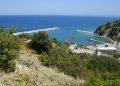
The archaeological park of Orikum in the Bay of Vlora offers a unique landscape from the green hill, surrounded by the Ionian Sea, the Pashaliman lagoon and the Karaburun peninsula.
Founded in the 6th century BC, the ancient city has left its mark on history during the Roman civil war in the mid-1st century BC, as a destination that served the rise of General Julius Caesar to absolute power in Rome.
Due to its geographical position, the bay along the edge of Karaburun is thought to have been used as a naval base from antiquity to the present day.
But now, the Albanian government plans to build a massive tourist complex there which will enter like an “elephant in a china shop” into the middle of an area with triple legal protection because of its cultural-heritage values, its natural habitat and the active Pashaliman naval military base.
Recently, the Strategic Investments Committee chaired by Prime Minister Edi Rama has granted “strategic investor” status to an Italian entrepreneur to develop the project of a tourist resort over 25 hectares of public land bordering the Pashaliman military base — a key point for the Albanian Naval Force.
Under the decision, the project’s footprint overlaps with the ancient city of Orik, a first-category cultural monument, and with the lagoon to its south-east, while the beach stations for the resort’s clients are envisaged to be built several kilometres further at the western tip of the Karaburun peninsula — at Cape Shëngjergj — also a protected area as a Category IV Managed Natural Reserve.
“This project tramples underfoot all the laws of natural heritage and cultural heritage. It tramples them all underfoot,” Taulant Bino, environmental activist and head of the Albanian Ornithological Society (AOS), told BIRN. “It means that the strategic investment is above every other law in Albania,” he added with irritation.
The “Pashaliman Laguna Eko Resort” project is being developed by the company “Meta Resorts Albania”, owned by Dante Mazzitelli, a builder and the owner of a local television station in Bari with a turbulent history of run-ins with the Italian prosecutor’s office in recent years. He has been investigated for suspicions related to corruption or fraudulent bankruptcy procedures, but in both cases the court has dismissed the charges.
Data secured by BIRN shows that, in setting up his business in Albania, Mazzitelli was assisted by Laura Plaku (Saro) — head, since September 2023, of the Albanian Investment Development Agency (AIDA).
In her capacity as director of AIDA, Plaku also runs the Technical Secretariat of the Strategic Investments Committee. Asked by BIRN, Plaku claimed that she had not had any financial relationship with Mazzitelli’s company and that she was not in a conflict of interest for the position she currently held.
The Prime Minister’s Office did not respond to BIRN’s questions by the time this article was published. Mazzitelli was unreachable, and questions sent through his representative office in Tirana went unanswered by the time of publication.
The threat to the Pashaliman base

The Pashaliman base was built in the 1950s in communist Albania, when the Soviet Union brought 12 submarines and turned it into the only naval base it controlled in the Mediterranean. After the rupture of relations between Tirana and Moscow in 1961, Pashaliman remained a naval military base hosting the four remaining submarines and other smaller ships.
The base was looted during the unrest of 1997 and three of the submarines were sold for scrap. But its territory remained intact and part of the Plan for the Deployment and Spread of the Armed Forces for more than two decades — a status that protects properties on the inventory of the Ministry of Defence from being alienated.
Nevertheless, this did not last forever.
Just seven months ago, part of the 25-hectare area where the “Pashaliman Laguna Eko Resort” project is to be located was excluded from the Plan for the Deployment and Spread of armed forces, through a decree by President Bajram Begaj that is kept “secret”.
Under the decision of the Strategic Investments Committee, the project’s footprint affects property No. 1314 of the Ministry of Defence, known as the former Southern Naval Flotilla in Pashaliman, removed from the Plan for the Deployment and Spread by decree No. 24 of 3 February 2025.
The tourist project also affects other military facilities important for the functioning of the Pashaliman naval base.
“Within the area targeted for investment is facility No. 25, used by the Land Force Command, the Substation and the Electric Cabin from which the Pashaliman Naval Base is supplied with electricity, and which is also in joint use as the main thoroughfare to the Ship Construction and Repair Yard (KNRA), to the Southern Naval District (DDJ) and to private entities carrying out various activities on the Karaburun peninsula,” the Strategic Investments Committee decision states.
Assessing Pashaliman as the main base of the Naval Force and a strategic space for Albania’s defence, the former head of the Naval Force, Artur Meçollari, told BIRN that this decision threatens national security and relations with NATO.
Meçollari recalls that since 2019 the Ministry of Defence has offered the NATO Supreme Command the Pashaliman naval base and the Bay of Vlora as a NATO naval base, an offer subsequently repeated publicly by Prime Minister Edi Rama in 2022.
“But in February 2025, Bajram Begaj removed 80 hectares from the Plan of Action and Spread of the Pashaliman naval base, leaving the base with only 14 hectares. At that time they may have hoped that NATO would look toward Porto Romano,” Meçollari said.
“The question arises: now that the Pashaliman base has been reduced to 14 hectares, what will NATO do?” he added, stressing that “corruption is harming the operability of the Naval Force, but also relations with NATO”.
The connections in Tirana

Dante Mazzitelli, 70, is among the few foreign entrepreneurs to have won “strategic investor” status from the Rama government through his company Meta Resorts Albania. Founded in June 2021 with the object of investments in tourism, the company with capital of 100 lek does not appear to have carried out any activity to date.
Across the Adriatic, Mazzitelli and his family are known as builders in southern Italy and as the owners of the Metaresorts hotel chain and the Telebari television station. However, their company, Construzioni Generali, recently faced legal proceedings following an investigation by the Bari Prosecutor’s Office that raised suspicions of intentional bankruptcy with asset-shifting.
The charges were dismissed in July 2024 by the Bari Court, but the latter also obliges Mazzitelli’s company to financially guarantee the repayment of debts to third parties, following the decision on the restructuring of the debts.
Earlier, Mazzitelli was named by Italian media for concrete buildings on the Amalfi coast, a court case relating to public housing from which he came out innocent, and for hosting in 2011 at his hotel in Switzerland the former prime minister and chair of the Democratic Party of Italy, Massimo D’Alema.
Mazzitelli has visited Albania even earlier, but the traces of his business engagement date to 2021. According to the National Business Centre (QKB) extract, Meta Resorts Albania was assisted by AIDA’s current director, Laura Plaku (Saro), and her legal-consulting company PCG until November 2023, when her name was removed as the contact person for Mazzitelli’s company.
Plaku was appointed at the head of AIDA in September 2023, sending her consultancy company PCG into liquidation. Her name as the contact person for Mazzitelli’s Meta Resorts Albania was replaced by the studio Haloçi of Majlinda Haloçi, an accountant who also serves as administrator of the consultancy company that the former Italian prime minister, Massimo D’Alema, has set up in Tirana.
Plaku denied having any role in granting “strategic investor” status to Meta Resorts Albania in a message exchange with BIRN.
“No relationship that constitutes a conflict of interest for the position I currently hold,” she wrote.
Asked by BIRN whether Mazzitelli’s business had links to D’Alema in Albania, Haloçi said she was a consultant and dealt only with the procedures of the companies’ fiscal obligations.
“I have no status or knowledge that would help you with information of the type of who is in front or behind,” she said.
‘A unique case’

Approved in 2015 by the Rama government, the law on “Strategic Investments” has, over a decade, contributed to the concretisation of the southern coastline with residential and tourist resorts by a group of businesspeople close to the government, sparing neither the ecosystem nor the protected habitats. But the impact of the “Pashaliman Laguna Eko Resort” exceeds previous projects.
Under the Strategic Investments Committee decision, the state foresees participation in this investment, while the assessment is that there will be no environmental impact. The project, by the studio Archea Associati of architect Marco Casamonti, foresees, according to the decision, the restoration and renovation of existing structures and the construction of wooden accommodation structures to be placed “on floating platforms (palafitte)” in the Pashaliman lagoon.
But field experts and environmental activists told BIRN that the damage will be unavoidable.
“In my opinion, such a project should not be carried out, because it would destroy the entire historical landscape of the site, where archaeological, environmental and military heritage are intertwined,” archaeologist Saimir Shpuza, co-leader of the archaeological mission at Orik, told BIRN.
“According to the document, it appears that the wooden-house buildings in the lagoon would not interfere with the hill where the site lies, although we should not forget that on the other side of the lagoon lies the necropolis of the city. In addition, the military buildings to be ‘reactivated’ adjoin the city’s surrounding wall and surround the largest part of the site, which in itself is a public asset,” he added, stressing that many archaeological structures have also been documented in the lagoon.
For architect and urban planner Doriana Musai, the project is the most extreme example of the conflict between economic development and the protection of public assets. Musai stresses that the luxury tourism project enters a triple-protection area, creating, in her view, a dangerous precedent of mixing commercial tourism with security infrastructure.
“The concept of ‘reactivating’ heritage risks turning into the commodification of archaeology, eradicating the authenticity of Orikum as an ancient city and using it as decor for the resort’s clientele,” Musai said.
“This is a unique case in the world — this kind of intervention, where tourism enters with structures into three protected zones, not only annexing territory but also damaging it,” Musai said.
The head of AOS, Taulant Bino, is also worried about the project, which according to him conflicts with the law on Cultural Heritage and risks turning one of “the most singular lagoons in Albania” into an urban environment.
“The damage is immeasurable and, unfortunately, with the approval of the new law on protected areas there is no longer any obstacle,” Bino said. “If there were a stop or protection mechanism, it would be before the Strategic Investments Committee decision was issued, because once it is given, no one stands in its way,” he concluded.