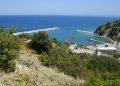
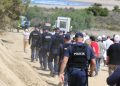
The solar energy revolution arrived without warning last September in the village of Boçovë in Fier — only a few kilometres from the Semani beach on the Adriatic — when heavy machinery began digging next to cultivated fields.
In the village no one knew what was happening, but alarm grew as the days passed.
Nikoll Ndoi, a teacher by profession, first heard that a private company was opening up a road. But his concern multiplied when he learned that the land he had used for 30 years was no longer his.
“It turns out a photovoltaic park is being built here, and the lands are no longer ours,” Ndoi said with irritation in late December. “For 30 years I have not been able to register it, then someone comes one day and gets it done without a problem,” he added.
The photovoltaic plant planned for Boçovë is one of the largest solar energy projects in Albania, approved by the government on 4 June 2025. The project has unsettled the lives of a small community of 14 families, since it overlaps with land they claim as theirs.
The permit has been issued to a new company called Albania Solar Power, but residents accuse businessman Pëllumb Salillari of being behind the project — and, in still unclear circumstances, of having appropriated their properties.
The Boçovë dispute is not isolated.
Since 2018, the Albanian government has issued dozens of permits for the construction of photovoltaic parks in Albania, fuelling its ambition for what it calls energy sovereignty — and even to be transformed into a net electricity exporter by the end of 2030.
But the government’s plans are disturbing the livelihoods of local communities, who watch as thousands of hectares of land around them are fenced off and covered by solar panels, undermining traditional livestock and land-use activities.
The government’s renewable energy policy is also viewed with suspicion by experts in the field, since most of the energy expected to be generated by photovoltaic parks is not destined for domestic consumption but for export.
“The plants have a capacity that goes up to 1 gigawatt, but with no obligation that this energy be sold to the Albanian state,” says Gjergji Simaku, a former deputy minister of energy in Rama’s cabinet until 2022, with concern.
“In this way Albania risks exporting clean energy and importing fossil energy, turning the energy transition into a paradox,” he added.
Salillari was not reachable for comment by the time this article was published.
Environmental risks

Albania has traditionally been one of the European countries with the highest production of clean energy, since over 90 per cent is generated from hydropower. Nevertheless, the country has suffered intermittent energy crises due to its dependence on climatic conditions.
Since 2018, the government of Prime Minister Edi Rama has turned its eyes to solar energy in order to diversify its sources. By the end of 2025, the Energy Regulator (ERE) had licensed 71 private companies for photovoltaic energy production, while the Ministry of Infrastructure and Energy together with the Council of Ministers have approved dozens of further permits which are in the process of financing or construction.
Together, the photovoltaic parks licensed by ERE are expected to produce more than 978 megawatts of electricity, or 30 per cent of Albania’s total installed electricity production capacity of 3,213 megawatts.
Photovoltaic technology is considered one of the most ecological forms of electricity production, with multiple environmental and economic benefits. However, experts argue that the sustainable development of this sector requires strategic decision-making with regard to land use and the livelihoods of local communities.
This does not appear to be the case in Albania.
Initially planned to be placed on barren land, the government changed its approach in 2024, when it approved legal amendments that opened the way for photovoltaic parks to be set up on pastures as well.
Meanwhile, a considerable number of licences are concentrated near the borders of protected areas or near the mouths of the Shkumbin, Seman and Vjosa rivers in the Fier region — known as important natural corridors for bird migration.
According to a report by the environmental organisation “All Green Center”, the procedures for leasing forest- and pasture-fund lands have often been rushed, without competition and with limited participation by the affected local communities.
Ola Mitre, head of “All Green Center”, told BIRN that the boom in the renewable energy sector in Albania is facing the challenge of sustainable development.
“Support for green energy must not come at the cost of losing natural capital, an asset for which the country has obligations not only to today’s citizens but also to future generations,” Mitre said.
Other environmental activists are concerned about the long-term impact of these projects on the livelihoods of local communities and on the environment.
Taulant Bino, president of the Albanian Ornithological Society, considers that many of these projects are bringing about a rupture in the traditional relationship of local residents with the land, as well as environmental impact. He also criticises the system of individual environmental assessments, which neglects the cumulative effect that several projects concentrated in a particular area can have on biodiversity.
“So far, environmental assessments have been carried out for each park separately, even when the plants are next to one another, neglecting their joint effect on the land, biodiversity and local communities,” Bino said.
“Around the world solutions have been found in which, even though photovoltaic parks are built, the area beneath them is allowed to be used by local residents for grazing. In Albania, companies are restricting access for local residents by erecting fences,” he added.
Environmental activist Lavdosh Ferruni also places the emphasis on environmental impact assessments and on local community participation in decision-making.
“In several cases, photovoltaic parks have been built on traditional pastures used for years by local communities, often without formal property documents but with rights inherited in practice. Although the technology allows panels to coexist with livestock grazing, the lack of consultation has stoked social tensions,” he said.
Environmental expert Kristi Bashmilli draws attention to the long licensing duration of these projects — for the next twenty or thirty years — which, according to him, brings a long-term change in land use.
“Local government institutions must be more vigilant towards these often abrupt changes. Especially in guaranteeing sustainable land use, the protection of agricultural land, of nature and of the interests of local communities,” he said.
Experts agree that the problem is not solar energy itself, but the lack of a strategic environmental assessment and a clear national map indicating where these parks should and should not be built.
Social tensions

In the municipality of Fier, several hundred hectares of land are already covered with photovoltaic panels, while new surfaces are expected to be covered in the near future.
Of the 71 photovoltaic plants licensed by ERE, 50 of them — 70 per cent of the total — are located in the Fier region, mainly stretched across the villages of Sheq, Topoja, Dërmenas and Darzëza along the Semani estuary.
In the village of Boçovë alone, the photovoltaic plant granted to Albania Solar Power is planned to extend over 50 hectares of land. The project foresees an installed capacity of 82 MW, an investment of 80 million euros and a 49-year exploitation period.
The 80 million-euro investment looks like an outsized burden for the small company owned by Ëngjëll Agalliu, registered in 2024 with capital of just 100,000 lek.
Affected residents say, however, that the work on the ground is being carried out by Pëllumb Salillari’s company “Bervi Construction”, which according to their own checks also turns out to own the land.
The residents claim to have acquired ownership of the land in the early 1990s on the basis of Law 7501 — but they have never been able to register it in their names. In the documents they hold, the land is recorded as arable, but they accuse local institutions of having changed its status to “barren land”.
“These plots here are private. They are mine and my brothers’, and we have proper AMTP papers for them,” says Sandër Muja, a local resident, while gesturing toward the boundary between private and state-owned properties.
“It seems they have cut corners; they have taken both the state’s land and ours,” he added.
Nikoll Ndoi says angrily that he has been paying taxes on the land for almost three decades and has tried several times to register it in the Cadastre, but the papers have been returned to him.
“How is it possible that, although over the past 3 decades we have tried several times to register it at the Cadastre, they did not register it for us, while now it turns out that someone else has registered it,” he asks suspiciously.
Ndoi told BIRN they had filed complaints with the police, the municipality, the Ministry of Agriculture and the Cadastre to correct the overlap, but had not yet received a response.
Selman Selami, another protesting resident, recalls that their lands have historically been used to grow wheat, alfalfa or oats since 1945, while in the Cadastre documents they appear today as “barren land”.
“I live off this land. We have all sown it throughout the year. I have 80 head of sheep, and if they take my land, then I will have nowhere to keep the livestock,” he stressed.
Unlike Boçovë, in the neighbouring village of Darzëza, the consequences of the photovoltaic parks are experienced more silently. The residents who initially trusted the promises of the private companies feel disappointed today.
“We have nothing good to show for it,” said the village elder of Darzëza.
“We took part in consultations, trusting promises that they would pave our cemetery road, the village road, that they would provide street lighting, but in reality nothing has been done — plus they are taking our water,” he stressed.
When asked about the residents’ complaints, the municipalities of the Fier region wash their hands of any responsibility.
“These activities are not licensed by the local government,” the Fier Municipality said in a written response, adding that the only benefit was the one obtained through taxes.
Wrong approach
The rapid development of photovoltaic energy in Albania initially started off as part of agreements with the government. In 2018, the Council of Ministers laid down a package of supporting measures for businesses in the renewable energy sector which, in addition to guaranteeing market access, also placed public land at their disposal.
After the amendment of the law “On Renewable Energy” in 2023, permits were directed toward fully private undertakings open to the free market. But opening the market without first meeting the country’s own renewable energy needs risks pushing the country into a spiral of costs that are not only environmental.
Under the National Plan for Climate and Energy, the government has committed to reaching a quota of 54.4 per cent of renewable energy in total consumption by 2030. But experts say this target is seriously at risk.
According to environmentalist Lavdosh Ferruni, even though solar energy is one of the most desirable sources in the world, the way the government is approaching this sector is wrong.
Ferruni emphasises that the country has a limited territory and that using land for large export capacities risks placing these initiatives at the service of the profits of private companies.
“It must be oriented toward 100% production for its own needs; net export requires large spaces and Albania does not have the conditions for it,” Ferruni told BIRN. “There is also significant interest from foreign businesses, hence the need to control the issuing of these permits,” he stressed.
Gjergj Simaku, currently an independent energy expert, is also sceptical for various reasons.
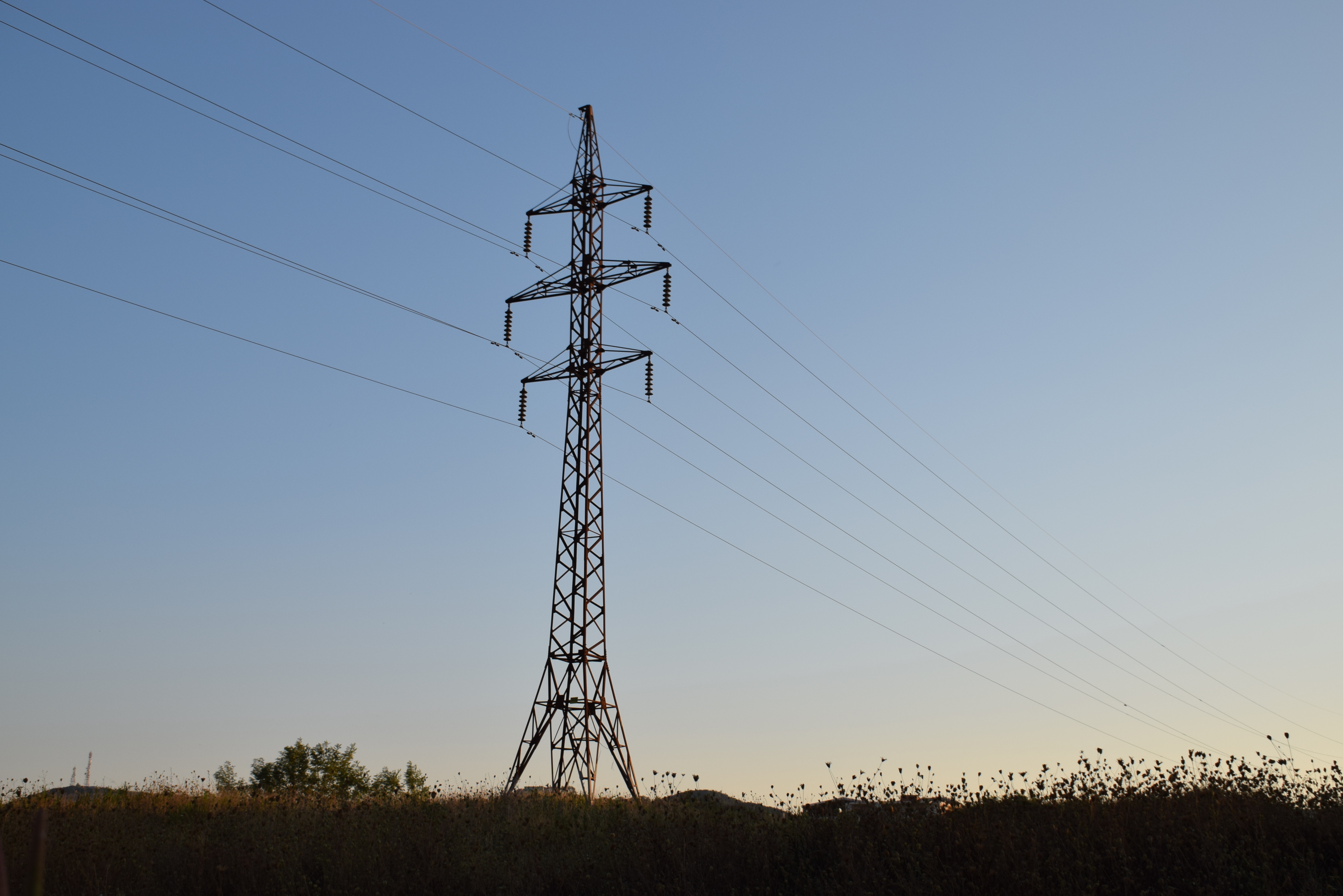
To reach the legal target of 54.4%, Albania, according to Simaku, would have to increase domestic electricity consumption by almost 30% by 2030, which is considered to be at the edge of the impossible. Another problem being side-stepped is the deterioration of the country’s electricity grid, which according to him generates losses and is in urgent need of regeneration.
“What is happening is absurd. Auctions have been forgotten; permits are now only being issued for the free market and we are sold the idea that we will consume that energy ourselves, but it is nothing of the sort,” Simaku said.
“If we start to feed the energy of these photovoltaic parks into the grid, the transformers will start burning out…,” he concluded.