At midnight on 17 May 2025, a Ukrainian student living at “Farborets väg 3” in Malmö, Sweden, was woken up together with her mother by a loud noise resembling glass shattering on the ground.
She came out to see what was happening at the window and was confronted by a frightening scene: silhouettes of men dressed in black with masks on their heads were running through the darkness toward a parking building. Other witnesses saw the masked men loading suspicious packages into cars and leaving on motorbikes.
“A car drove past at speed making a grating, frightening tyre noise,” the Ukrainian student told the Swedish police after the incident.
Initially notified of a violent robbery, the police found a surreal scene at the location.
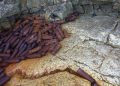
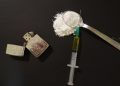
More than 231 kilograms of cocaine with a market value of 23 million euros was found scattered in the courtyard, on the road, on the stairs and inside an apartment.
Some of the packages were stamped with the “Manchester City” logo — they had fallen onto the ground from the robbers in their hurry, after being pulled out of bags marked IKEA and torn cardboard boxes. The apartment where the drug was being kept was also a crime scene, with bloodstains spread on a window with broken glass and on the curtains.
According to a voluminous court file from the Swedish authorities that BIRN has obtained, the police intervention marked the epilogue of a trafficking operation involving a colossal cargo of 1.5 tonnes of cocaine from Costa Rica to Sweden, which spun completely out of control because of a half-successful robbery by rival criminal groups.
The case is not just a crime story on the streets of Malmö, but a window through which one can see how organised crime uses international logistics, moves multi-hundred-million-euro cargoes across the ocean and recruits “experts” from across the world to do the “dirty work”.
According to the investigation file, criminal groups from Albania, Sweden, Norway, Belarus, Turkey, Bosnia, Denmark, the Netherlands and Belgium are behind the trafficking operation of the 1.5-tonne cargo and the robbery of part of it.
At least four Albanians have been identified as implicated, and one of them sits in the dock as a defendant in Sweden facing charges related to one of the links in the trafficking chain: that of taking the cocaine out of the port and transporting it to a base believed to be safe.
The Swedish authorities say they have asked for help from their Albanian counterparts in tracing three of the suspects, but in Albania the police, the prosecutor’s office and Interpol all say they have no knowledge of the case.
From Costa Rica to Helsingborg
To understand what happened at midnight on 17 May 2025 in Malmö — Sweden’s third-largest city — you have to go back several weeks in time.
On 23 April 2025, a sea container was being transported by road thousands of kilometres away from Sweden, from the city of Moín toward the port of Puerto Limón on the Caribbean coast of Costa Rica. According to data secured by Swedish investigators, the container was handed over empty to the carrier and two days later he returned it to the port loaded with bananas.
On 28 April 2025, the container was loaded onto the cargo ship “MSC ANISHA R”. In addition to the bananas, 1.5 tonnes of cocaine with an estimated market value of 180 million euros are believed to have been hidden inside it.
The drug’s voyage lasted around two weeks across the Atlantic Ocean, arriving first at the major European port of Antwerp in Belgium. On the same day, it set off on a second ship toward the port of Helsingborg in Sweden.
On 13 May 2025, at 14:48, the container touched Swedish soil at Helsingborg — a small town with picturesque buildings and historic castles. An hour later, the container was sneaked out of the port on a truck driven by a Belarusian citizen called Ilia Kirylau.
The investigations later showed that Kirylau had travelled to Sweden specifically to perform this service — having previously been tested on similar jobs in Germany and other countries.
The company importing the bananas reported the container missing and the case was referred by customs. From this moment on, the Swedish police set in motion to find the container and the persons involved, whose movements were reconstructed from street security cameras and mobile-cell tower tracking.
The investigations revealed that while the container was still at sea, a human machinery on the other side of Europe had already been set in motion and had planned almost everything.
A matter of life or death

International organised-crime networks rely not only on force or financial power, but especially on the right logistics. To manage this dizzying quantity of cocaine, a small operational team was urgently dispatched from Albania to Sweden.
Data secured from the court files obtained through a freedom-of-information request at the Malmö District Court identifies as suspects citizens Antonio Çepele, Klisman Hoxha, Toni (Taulant) Hyskaj and Murat Zyka — all four originating from the Fier region.
Murat Zyka, 32, is a resident of Malmö and the tenant of the apartment where the cocaine was stored and robbed, and one of five defendants in this case in Sweden. The legal position of the other three persons is still unclear.
The Swedish authorities have established that Antonio Çepele and Klisman Hoxha flew on a commercial flight from Tirana to Malmö on 12 May 2025, the day before the container with the drug arrived in Helsingborg. On the same day, Toni (Taulant) Hyskaj also travelled to Malmö from Amsterdam.
According to the investigation file, the Albanians were recruited to take the cocaine out of the port and transport it to Murat Zyka’s apartment, on the street “Farborets väg 3” on the outskirts of Malmö.
In the Swedish file, Çepele is identified as the man with “Calvin Klein”, while Hoxha as “the White Trainers”. The first move they made was to take a rental car, while through cameras and mobile cell towers the Swedish authorities identified their itinerary, mainly around the apartment where Zyka lived. The latter handed it over to the three new arrivals and sent his wife and child for a few days to another Albanian who lived in Malmö.
In his testimony to the Swedish investigators, Zyka insisted that until the moment the cargo was delivered to his home and the packages were opened, he did not know what was at issue. Zyka said he had been hired for 700,000 Swedish krona [around 66,000 euros] to find a parking spot for the truck by an acquaintance who phoned him from Albania, identified by him as Adriano.
He also said that when he realised he was hosting drugs, he could not pull back.
“The boss told me it was a matter of life or death… I had no choice; they put pressure on me,” he told the investigators.
According to data gathered by BIRN, Çepele, Hoxha and Zyka have no prior criminal records in Albania and are nearly unknown to local police in Fier.
Hyskaj, on the other hand, has been investigated earlier for drug-related crimes in 2016 in Switzerland, according to an Interpol document that BIRN has obtained.
The Norwegian connection
In parallel with the group of three Albanians, three Norwegian citizens also rushed to Malmö, one of whom had earlier ties with Albanians involved in drug trafficking.
The group was led by Martin Ari Parlemen and two young men with little experience, called Mohammed Abdi-Weli and Elias Hadibi, the latter only 17 years old.
Data from the Swedish file suggests that Parlemen had been recruited by “Jonny Weed” — an Albanian believed to be in Spain, with whom he had previously trafficked cannabis.
Parlemen kept his contacts with “Jonny Weed” on the “Signal” application, where the Swedish authorities also found his recruitment conversation dated 11 May 2025.
In the messages, Jonny Weed addressed him in Albanian as “Vlla” (“Bro”).
“Vlla… It’s urgent. I have a very good job in Sweden. It’s easy,” reads the message.
Parlemen is suspected of not doing this job for the first time; on his phone the police found photos in which he was posing with wads of money, with Kalashnikovs or with other weapons. He accepted the job and took with him as camouflage Mohammed Abdi-Weli and Elias Hadibi — who were to disguise the trip as an attempt to film a music video. Elias was the rapper and Mohammed the manager.
After arriving in Malmö, they booked a small apartment on the outskirts and rented a covered “Iveco” van, which without the group’s knowledge was equipped with a GPS tracker that helped the police investigations. According to the Swedish authorities, the “Iveco” truck was used to transport the drug from the banana container at the port to Zyka’s house in Malmö.
But Mohammed Abdi-Weli and Elias Hadibi showed signs of panic. After a period under arrest, Mohammed admitted involvement and gave a half-confession.
He nevertheless insisted that he did not know what he was getting into and that he had accepted the job because of a financial debt, and that it was the creditor who had pushed him to take part, but he did not identify him. In his testimony he says he was scared the whole time and they were frightened when the Albanians did not return the “Iveco” car they had rented.
The cocaine handover

The action to take the cocaine out of the port began on the morning of 13 May 2025, coordinated between the Albanians who set off from a hotel near Malmö airport, the Norwegians from their rented apartment, and the Belarusian Ilia Kirylau, who also set off with his truck toward the port of Helsingborg. The Swedish police reconstructed the scene of the events through data gathered from the cars’ GPSs, the mobile-cell towers, and security cameras on the street and in the places frequented by the persons implicated.
Around midday, Kirylau stopped on the road to pick up as a passenger one of the Albanians, identified in the file as Klisman Hoxha. In his testimony after his arrest, Kirylau claimed that the person had been hitchhiking.
After the Belarusian secured the container and left the port, the data from the mobile-cell towers shows Çepele on the move near the port, appearing to lead the truck. Hoxha, on the other hand, appears to have got off the truck and is no longer seen on the security cameras tracking the latter.
Almost 37 minutes after leaving the port, the groups join up at a rest area in Landskrona — a small town roughly halfway between Helsingborg and Malmö.
The first to arrive is Çepele, who makes several loops around the location. Then the Belarusian’s truck with the container, the Norwegians’ “Iveco” van and the “Toyota Auris” car driven by Çepele park one after the other.
Five minutes after they have stopped at the rest area, the cameras capture the doors of the container being opened, the plastic wrap being torn, and the persons involved moving the cocaine from one car to the other. The entire loading-unloading operation lasts only five minutes, from 16:30 to 16:35.
Immediately after this, the “Iveco” leaves the rest area, but its control is now in Albanian hands. The Norwegians leave immediately after them with the Toyota Auris and the two parties stop about an hour and 30 minutes later at a new rest area.
On the evening of 13 May, between 7 and 8 p.m., the “Iveco” truck with the cocaine arrives at the address “Farborets väg 3” and the drug is unloaded at Zyka’s house.
The Norwegians, on the other hand, are stopped by the police around 19:30 in the evening and held in cells for inspection until the afternoon of the next day. In the file, the arrest is described as an operational move to influence the actions of the other parties involved.
Meanwhile, the Albanians are filmed moving freely.
On the evening of 13 May, the “Iveco” truck was observed parked outside Malmö airport, near the hotel where Çepele and Hyskaj were staying, while Klisman Hoxha is suspected of staying at Zyka’s apartment.
The movements resume immediately on the morning of 14 May. Initially Kirylau, together with the truck, tries to leave Sweden but is arrested in the evening as he tried to take a ferry. The container now bears no trace of the drug, only an empty space showing that a large quantity of “bananas” has disappeared.
On 14, 15 and 16 May, the Albanians circulate on the streets around the address where the drug is located, using the “Iveco” and then another rental car. On the evening of 16 May, Çepele and another young Albanian, to whom the police give no role in the events, fly to Tirana, leaving behind only Hoxha and Hyskaj. The security cameras have filmed him smiling and calm.
On 17 May, the police records no movement of the parties. But in the afternoon, on the street “Farborets väg 3” a black Volkswagen Passat appears, bringing a rival organisation to the scene.
The cocaine robbery

The residents of “Farborets väg 3” saw suspicious car movements on the afternoon of 17 May, but the strike happened only just after midnight. According to witness statements, the robbers arrived at Zyka’s apartment with multiple forces, attacking it from the main entrance and from the balcony.
Witnesses recounted that two dark-coloured motorbikes and a compact black Volkswagen-type car arrived first at the courtyard at speed. The latter was later linked to Mostapha Ayoub, a person who, according to the file, had been previously detained for drug-related crimes.
Witnesses also identified other cars that stopped on the road or circled the dwelling several times, among them a BMW and a Tesla. The first noises that broke the silence of the night were those of the apartment’s windows.
The Ukrainian neighbour, who lived next to Zyka, heard the noise around 00:00. She testifies to the police: “It sounded as if it was coming from the direction of the stairwell. It sounded like a piece of glass that fell to the ground and shattered.” Four minutes later another identical noise was heard, and the Ukrainian student heard men’s voices coming from the road.
Inside the apartment, a confrontation likely took place. Bloodstains were found on the bedclothes used for sleeping, on the sofa in the living room and on the curtains. But there do not appear to have been any seriously injured persons or victims.
Witnesses saw how the group of attackers quickly loaded the drug into the cars that were waiting. In their hurry, the packages were falling on the way and several of them remained scattered on the road or in the surrounding area. This lasted around 33 minutes, until the police arrived on the scene, alerted by the neighbours.
According to the Swedish investigators, the robbery was organised by an unidentified person, known to the authorities by the pseudonym “Angel of Death”, and was carried out by people of Danish, Swedish and Bosnian nationality.
Most of the persons involved fled, but the police caught in a car near the events three cousins of Danish nationality — Ahmad Junes, Ahmad Salem and Ahmed Jehad. All three denied involvement in the events.
Later investigations revealed the involvement of Mostapha Ayoub and Ferid Musinovic, after Danish investigators followed the trail of the packages with the Manchester City logo to Stockholm and other Swedish cities. The police found Ayoub’s DNA traces on the seized packages and discovered images of the drug on Musinovic’s Signal messages. Investigators say he was trying to sell it.
In the messages found by the Swedish police, exchanged between Musinovic and the “Angel of Death”, regret was expressed over the partial robbery. In a later message there is talk of another robbery. “This time I hope you’ll get the lot,” writes the “Angel of Death”. “Inshallah,” replies Musinovic, who uses the pseudonym Floki.
The Albanians’ escape
According to the court file of the Swedish authorities, the three suspect Albanians left Malmö one after the other; Antonio Çepele toward Albania, while Klisman Hoxha and Toni Hyskaj toward Amsterdam. The only one facing justice is Murat Zyka, who was arrested on the evening of 18 May 2025.
From the search of his home after the robbery, the police uncovered personal items left behind in the rush, including a mobile phone, Hoxha’s “white trainers” and a dark-grey backpack, filmed on Hyskaj’s shoulders during police observations.
Further checks revealed photos and videos of Hyskaj and Hoxha at Malmö airport on 19 May, the day both flew to Amsterdam.
The current legal position of the three suspects in Sweden is unclear, but the Swedish authorities stress in the file that they have requested help from Albania to investigate them. The file even includes data from the mobile-cell towers of two phones in Albania, which document the suspects’ movements in the areas of Roskovec, Fier and Vlora.
Çepele, Hoxha and Hyskaj were unreachable by BIRN. Communications with the Fier police, the Special Prosecution Office and Interpol shed no light on any possible investigation taken against them in Albania, since the institutions said they were not aware of the case.
The Fier Prosecutor’s Office also told BIRN in a written response that “according to the data in the electronic registers, no criminal case has been registered for these citizens in 2025–2026”.
Left behind in Sweden, Murat Zyka also tried at first to evade the police, throwing his and his wife’s phones into the sea. After his arrest, he was forced to seemingly cooperate.
Zyka told the Swedish authorities that he had been drawn into the events by a phone call from an Albanian acquaintance who had previously stayed in Sweden, who had asked him to secure a safe spot for a car in exchange for a payment. Zyka says that when he sent the persons with the “Iveco” to the spot he had chosen, they refused to stay there.
“The boss said the car can’t stay outside,” he testified.
Zyka also stated that he had felt forced to use his home as a warehouse.
“I thought only of my own life and that of my children. I was terrified, but as I have said all along, I thought of phoning you,” he told the police. “Then I thought: I’ll phone, but they will find me and they will kill me.”