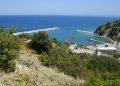
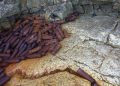
On the western side of Sazan Island, where waves crash against steep cliffs, lies an area sailors have dubbed the “Hell’s Throat” — a gateway to the underworld.
On the surface, the transparent waters offer a breathtaking, almost idyllic Mediterranean postcard — precisely the kind of natural beauty expected to attract the global tourism elite. But dive just 5 to 30 meters below the surface, and the tourist postcard turns into a war scene frozen in time.
There, across a 5,000-square-meter stretch of sea, 200-millimeter artillery shells from the Second World War, anti-submarine mines, and tons of explosives ready to detonate lie silently among the marine flora.
Official documents from the General Staff of the Albanian Armed Forces, along with testimonies from people familiar with the island, say that similar “mined” areas exist on nearly every side of Sazan. The unexploded ordnance has not stopped the government and foreign investors from pursuing plans to build a resort and tourist marina on the island.
At the end of 2024, the government of Prime Minister Edi Rama granted “Strategic Investor” status to Atlantic Incubation Partners LLC, a company linked to Jared Kushner, son-in-law of U.S. President Donald Trump. The promised investment, in which the Albanian state is a partner by providing property and other incentives, is valued at 1.4 billion euros. Beyond Kushner, who first made the idea public, Qatari billionaires have also become involved in the project.
The plans, which remain theoretical and exist only on paper, changed again at the end of last year when the Strategic Investments Committee extended the deadlines for the project – which foresees transforming 45 hectares of the island into a network of luxury villas and resorts – and increased the benefits granted to the investor.
To facilitate the investment, the Albanian government introduced new legislative concessions. In addition to earlier controversial amendments to the law on Protected Areas, adopted despite objections from the European Union, exclusive changes were also made to the law on tourist ports to allow no-bid contracts for strategic investors. Above all, the Strategic Investments Committee has now tasked the Ministry of Defense with clearing the island and surrounding waters of unexploded ordnance.
But while the government has rolled out the legislative red carpet on the surface, the underwater reality remains stubborn.
Data from the General Staff of the Armed Forces, provided in response to a freedom of information request by BIRN, along with testimonies from navy experts, fishermen, and marine biologists, reveal that Sazan and its surrounding waters are effectively a minefield. Eliminating this potentially deadly legacy would require major financial resources, specialized divers, and a large-scale clearance operation.
Artur Meçollari, a former senior naval officer and maritime expert, said the presence of unexploded munitions makes the island dangerous for civilians and tourists alike, raising serious questions about the viability of the tourism development plans, which depend on people being free to move, swim, and sail safely in surrounding waters.
“The question is: after construction is completed, will tourists actually be safe?” he asked. “If you only clear the area where construction will take place, the rest will remain a problem for the future,” Meçollari added.
Four danger zones

Sazan Island served as a naval military base during the communist regime and is still administered by the Ministry of Defense. To pave the way for the project to obtain strategic investor status, President Bajram Begaj urgently signed a decree removing a military training zone from the Armed Forces deployment plan.
Yet the island’s century-long legacy as a military zone has left its scars behind.
“On Sazan Island and in the waters surrounding it, despite the work carried out to identify and clear unexploded ordnance… there remains the possibility and risk of the presence of unexploded munitions on land, along the coastline, and in the surrounding sea waters,” the General Staff of the Armed Forces wrote in a response to BIRN.
The General Staff said it had identified four areas with a massive presence of unexploded ordnance in the waters around the island.
According to the Armed Forces, several military clearance operations were conducted between 2013 and 2015 in three of these zones, but the amount of explosives remaining is still alarming. In Zone 3 alone, in the island’s northeast – considered the most contaminated area – around 30 tons of munitions of various calibers were removed and destroyed.
“In this area, munitions of different calibers, as well as gunpowder, were found scattered across an area of approximately 7,000 square meters, both with and without fuses. Around 30 tons of munitions of various calibers were extracted and demolished,” the response states.
In the other areas, Zones 1 and 2, where several thousand square meters were also identified as contaminated, the General Staff did not specify how much ordnance had been removed from the sea, but cautiously noted that unexploded munitions could still remain there.
“Despite the clearance operations carried out in Zones 1, 2, and 3, there remains the possibility that sea currents may have exposed and displaced other unexploded munitions, which during the operations may have been covered by sand and seabed sediments,” the response states, emphasizing that even in the areas already treated, unexploded ordnance may still be present.
However, according to the General Staff, the main problem lies in the fourth area — the so-called “Hell’s Throat.”
Data from the Ministry of Defense show that in this area, west of Sazan, unexploded ordnance is present across a 5,000-square-meter stretch at depths ranging from 5 to 30 meters.
“No clearance operations have been carried out in this area,” the General Staff stressed.
The situation is confirmed on the ground by fishermen and other visitors to the area.
A 60-year-old diver, who asked to remain anonymous, said the depths around Sazan remain an open weapons depot and that the army’s partial operations are often no match for the forces of nature.
“The sea is difficult to clean,” he said. “An operation was carried out, but the sea keeps bringing up new ones. It’s not easy to clear.”
He recalled seeing with his own eyes more than 50 Italian 200-millimeter artillery shells in the “Hell’s Throat,” where he used to dive for octopus.
The fisherman said he knows the weapons well because he served in the navy from 1985 to 1987, specifically on minesweeper vessels tasked with clearing naval mines.
“Near the beach, in the area known as Sazan Beach, there are anti-submarine mines. There are also large artillery shells,” he said, recalling his years in naval service.
“We didn’t dive specifically for the munitions, so I can’t tell you exactly how many there are, but there are a lot,” the former sailor added.
According to him, the danger posed by these weapons is silent but potentially deadly.
“These – especially the anti-submarine mines – in theory have their detonation mechanisms disabled, but the explosives are still there. If you don’t disturb them, there’s no danger. But if they are touched or moved, the consequences could be fatal,” he said.
High cost of demining

Plans for Sazan Island and its transformation into a “tourist paradise” are not new.
The abandoned former military base has repeatedly become the focus of multi-billion-dollar dreams in Albania, including proposals for casinos and other forms of commercial exploitation.
In their response to BIRN, neither the General Staff of the Armed Forces nor the Ministry of Defense answered questions about how much it would cost to clear Sazan, both on land and at sea.
“During 2025, the Armed Forces carried out reconnaissance operations to assess the terrain and calculate the assets and methods required to conduct clearance operations for unexploded ordnance across the island,” the General Staff said.
But while the military headquarters speaks in cautious bureaucratic language, experts paint a far more dramatic picture of the situation awaiting investors and the state.
For Artur Meçollari, the deadlock is not merely technical, but above all financial and logistical.
“The problem is not that it cannot be done, but that it requires a huge amount of money, and it is unclear where the explosives would be dismantled,” he said. “That’s the major issue — to clear the area, the munitions have to be transported to a demolition range and placed somewhere else,” Meçollari added.
He recalled previous naval operations, particularly between 1999 and 2002, during which 37 tons of munitions were removed from clearly identified areas.
“The navy paid for it and carried out the operation,” he recalled. “It took one month, with 60 people engaged exclusively for this task, including four or five divers working at depths of up to 10 meters,” he explained.
According to him, underwater explosive ordnance disposal (EOD) operations are extraordinarily complex, while the Armed Forces face shortages in the specialized personnel needed to carry them out.
“It requires a huge commitment of time and highly specialized diving capacities,” Meçollari said, adding that post-clearance inspection operations are the most complex stage of the process.
According to Meçollari, the munitions on Sazan do not pose a major threat to port operations or large-scale navigation, but the equation changes entirely once the area is turned into a tourist village.
The dangers posed by unexploded ordnance are also confirmed by Simo Ribaj, a biologist who frequently conducts diving expeditions in the area to study marine flora and fauna. He said visitors are often frightened by the piles of explosives they encounter.
Yet according to him, the danger is not limited to the sea.
“On the island itself, the situation used to be much worse 10 to 15 years ago. It was cleaned up, but the ordnance is still there, because it gets buried and uncovered again, and remains potentially dangerous,” he said.
According to Ribaj, the island requires inspections using specialized equipment, since many munitions may have been hidden over time but could reappear through erosion or new construction works.
“The ones in the sea are more stable and easier to locate than those on land,” he stressed, confirming that he personally saw munitions underwater as recently as a year ago.
The presence of unexploded ordnance raises serious questions about plans for beaches and elite tourism. Ribaj said he had seen artillery shells across almost the entire perimeter of the island, including near the port, emphasizing that clearing such difficult underwater terrain “requires major work and must be approached properly,” and that the process “can only be carried out by field experts.”
For the biologist, the presence of these remnants of war is fundamentally incompatible with the hospitality industry and large flows of tourists.
“They are absolutely dangerous, and that simply does not go together with tourism,” he concluded.